Home / Loop3D – Dynamide CF vs. GF: Which Reinforced Filament Should You Choose?
Choosing Ultra-Strong FDM Filament: Carbon Fiber or Glass Fiber Reinforced Nylon on the Loop3D
More and more manufacturing companies are running into the same limitation: standard FDM materials such as PLA and PETG are excellent for prototypes, but fall short when a part is subjected to real mechanical loads. For those looking for an ultra-strong material that can withstand both mechanical stress and elevated temperatures, fiber-reinforced nylon is often the next step. Carbon fiber and glass fiber are the two dominant reinforcement options.
In this article, we explain how they differ, which production applications each is best suited for, and why the printer used to process them can be just as important to the final result as the filament itself.
Why choose fiber-reinforced nylon for functional parts
Fiber-reinforced filaments are essentially nylon (polyamide) with short fibers added to the material. These fibers carry loads that the base polymer alone cannot handle, much like reinforcing steel does in concrete. The result is a printed part that is significantly stiffer and more dimensionally stable, with reduced warping and improved resistance to heat. This shifts FDM from prototyping into the realm of functional, load-bearing parts: jigs and fixtures, machine components, tooling, and structural parts that have to withstand demanding conditions day after day in production.
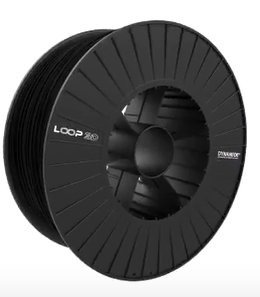
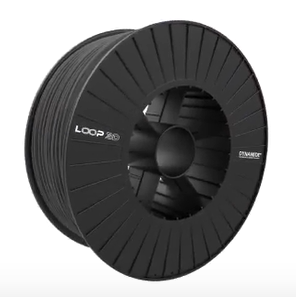
When seriously comparing carbon fiber and glass fiber, one thing is important: the base polymer has a major influence on material behavior. Carbon fiber-reinforced PLA, for example, behaves very differently from carbon fiber-reinforced nylon. A fair comparison is therefore only possible when the fiber is the sole variable. That is exactly what the Dynamide series from Loop3D makes possible: Dynamide CF and Dynamide GF use the same PA base polymer, so the differences you see can genuinely be attributed to the fiber reinforcement.
Dynamide CF: Stiff, Strong, and Lightweight
Dynamide CF is a carbon fiber-reinforced polyamide. The carbon fibers provide the highest stiffness and tensile strength within the series, combined with low weight. Parts remain dimensionally stable under mechanical load and retain their dimensional accuracy, even at elevated temperatures. With a tensile strength of up to approximately 105 MPa and a heat deflection temperature of up to 214 °C, it is the logical choice when stiffness, dimensional stability, and an optimal strength-to-weight ratio are critical. Typical applications include structural components, lightweight construction parts, and precision tooling.
Dynamide GF: Tough and Impact-Resistant
Dynamide GF is a glass fiber-reinforced polyamide. Where carbon fiber excels in stiffness, glass fiber has the edge in toughness and impact resistance. The material can deform slightly before failure rather than breaking in a brittle manner, allowing it to better withstand impact loads and vibrations. This makes Dynamide GF well suited for parts that need to absorb shocks and repeated loads: housings, mechanical components, industrial tooling, and structural parts where toughness is more important than maximum stiffness. In addition, glass fiber is generally the more cost-conscious choice for functional parts produced in larger quantities.
The Numbers Side by Side
Because both materials are based on the same nylon, a direct comparison clearly shows what you gain and what you trade off. The values below are taken from the official Loop3D datasheets.
Property
Dynamide CF
Dynamide GF
Tensile strength (XY)
105 MPa
85 MPa
Elastic modulus (XY)
7,500 MPa
4,400 MPa
Flexural strength
165 MPa
135 MPa
Impact strength (Charpy)
12.5 kJ/m²
16.5 kJ/m²
Elongation at break
3%
3.5%
Density
1.17 g/cm³
1.2 g/cm³
Heat Deflection Temperature (1.8 MPa)
195 °C
—
The pattern is clear: Dynamide CF is stiffer, stronger, lighter, and more heat-resistant, while Dynamide GF scores higher in impact resistance and elongation. This trade-off between stiffness and toughness is exactly what the material choice comes down to.
Which Material Is Right for Your Production?
The right choice depends on the function of the part. If stiffness, dimensional stability, low weight, or heat resistance are the priorities, Dynamide CF is the better choice. If the part primarily needs to withstand impacts, vibrations, and repeated loading or if cost is an important factor for larger production runs Dynamide GF is often the better fit.
In practice, it comes down to whether you need a part that is maximally stiff and dimensionally stable, or one that is tougher and more forgiving under unexpected loads.
If you are unsure which one to choose, it is worth printing a test part beforehand. The differences on paper do not always translate directly to your specific geometry and loading conditions, and a trial run can help prevent surprises when scaling up to production.
From individual parts to series production
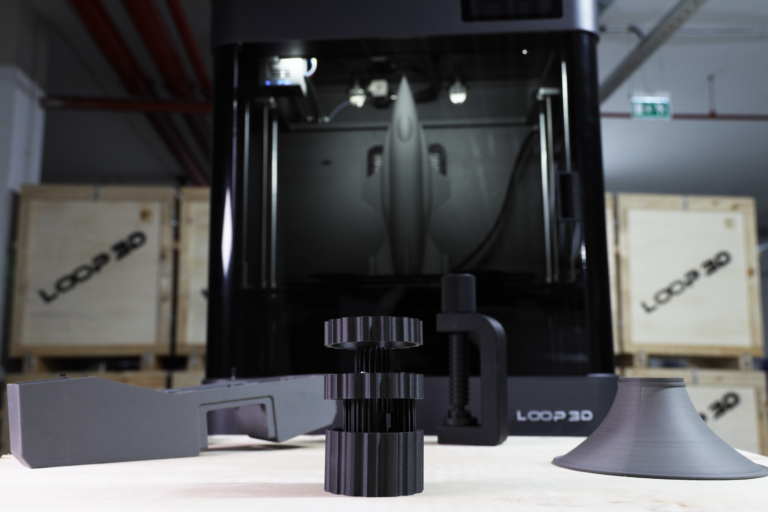
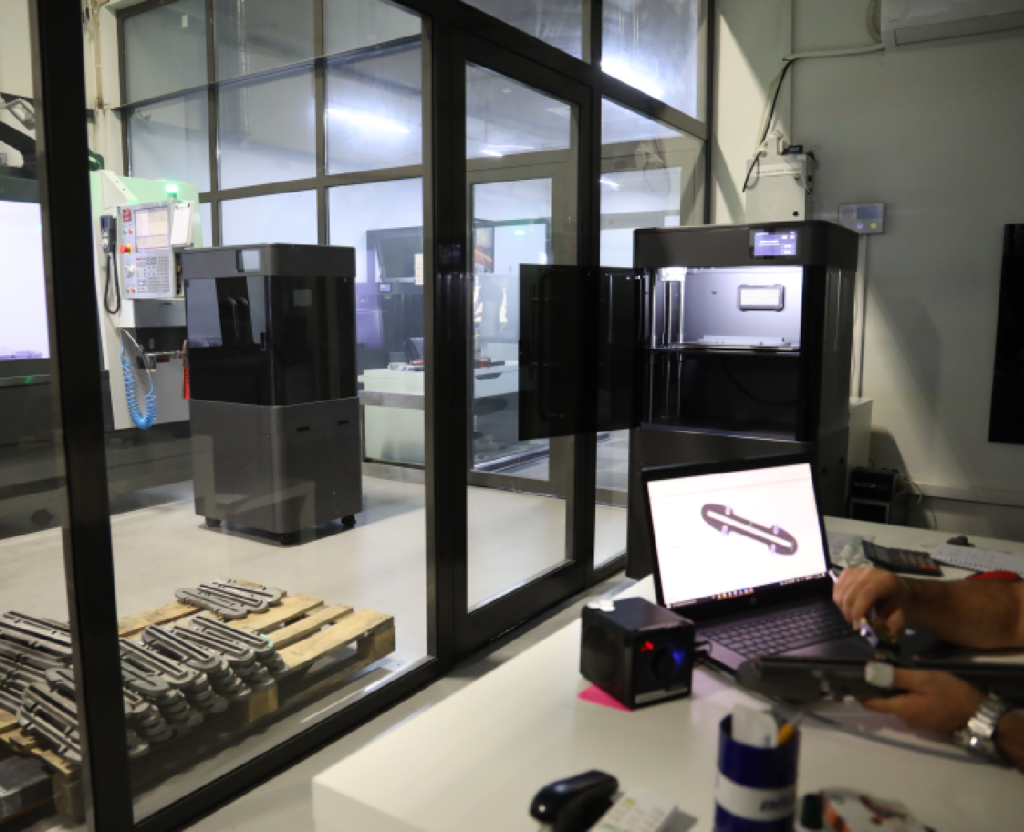
For companies looking to go beyond producing individual parts, the Loop3D is more than just a printer for high-strength materials: it is a platform for manufacturing functional parts at production scale. Large-format industrial FDM, combined with a process optimized for these materials, means that Dynamide CF and GF can be used reliably for real production not just one-off prototypes. This makes in-house printing a serious alternative to outsourced CNC machining or injection molding for small to medium production runs, with shorter lead times and complete control over the process.
For companies looking to produce ultra-strong, temperature-resistant parts in-house, the choice is therefore not just about selecting a filament, but about choosing a complete system. The choice between carbon fiber and glass fiber determines the properties of the part; the Loop3D determines whether you can achieve those properties consistently, time after time.
For ultra-strong FDM parts, fiber-reinforced nylon is the logical choice, and the decision between Dynamide CF and GF ultimately comes down to the trade-off between stiffness and toughness. Just as important is the machine used to process them: only on an industrial printer designed for these materials can their properties be realized consistently.
If you want to bring the production of ultra-strong, temperature-resistant parts in-house, our specialists would be happy to help you find the right combination of material and Loop3D printer for your application.
Dynamide CF and Dynamide GF are exclusively available for Loop3D 3D printers.