


Home / Sealing Porous Parts with Impregnation Sealant | Syntec
Anyone looking for an impregnation sealant usually has a specific problem or application in mind. A component starts leaking after machining. Corrosion develops underneath a sprayed coating. Concrete becomes stained. A housing absorbs moisture and begins to deform. Different applications, but often the same underlying cause: the material is porous.
The difference is important, yet the two methods are often confused in practice.
A coating or paint creates a layer on top of the surface. The pores are covered, but the open structure remains underneath. As long as the coating stays intact, this works perfectly well. However, once the coating is damaged, the porous structure is exposed again. In addition, coatings often change the appearance of the component, add layer thickness and can affect dimensional accuracy.
An impregnation sealant works in a completely different way. Its low viscosity allows it to be drawn into the pores through capillary action, where it subsequently cures. Instead of covering the component, the porous structure is filled from within. In most cases, the surface retains its original appearance, dimensional changes are minimal, and the sealing effect takes place inside the material rather than on top of it.
This second approach is particularly suitable when leak tightness is required, when corrosion starts within the porous structure, or when the appearance and dimensions of the component must remain unchanged.
Porosity is very common. It is not necessarily a defect, but often simply a result of how a material is manufactured or structured.
A casting solidifies from the outside inward and can develop small internal voids during this process. A thermally sprayed coating consists of particles deposited onto one another, leaving microscopic spaces between them. Sintered and powder-metallurgical materials naturally contain an open structure. Concrete, plaster, ceramics and natural stone are porous by nature. Cast plastics can contain air pockets and pinholes. And in materials built up layer by layer, such as 3D-printed parts, the individual layers do not always bond completely without microscopic gaps.
Capillary-active impregnation systems do not necessarily require specialised equipment. Depending on the application, dipping, brushing, spraying or injection may be sufficient, provided the surface remains wet for several minutes. This gives the sealant enough time to penetrate deeply into the porous structure.
It is important that the surface of the component is clean, dry and free from grease. Contamination inside the pores can prevent the impregnation sealant from penetrating effectively.
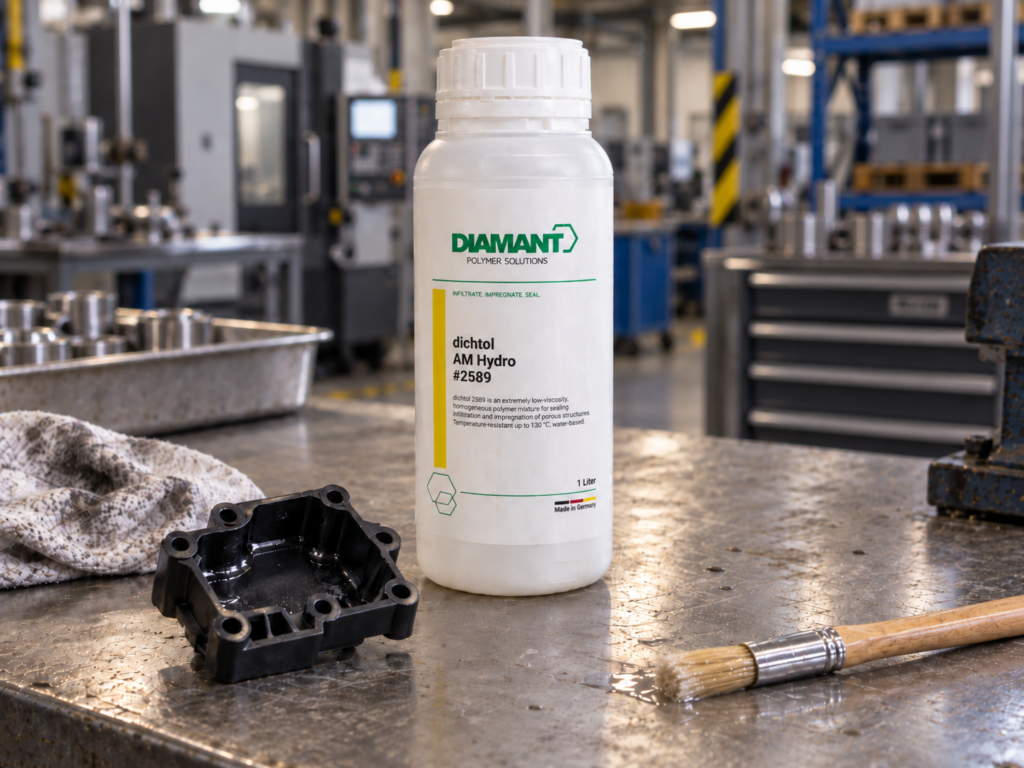
dichtol AM Hydro is a good example of this type of product. This impregnation sealant has a low viscosity, making it particularly suitable for application by brushing or dipping.
There is nothing to impregnate on a smooth, non-porous surface. Without open porosity, there is nowhere for the sealant to penetrate, and a dry layer only a few micrometres thick has little effect on its own.
Materials such as PP, PE and silicone can also be problematic because adhesion is poor, while water-based systems generally do not wet these surfaces effectively. Gaps and leaks that exceed the specified pore size range require a filler or repair compound rather than an impregnation sealant. Impregnation products should also not be used as a wear-resistant layer or decorative finish.
Another important consideration, and one that is often addressed too late, is food contact. Compliance must always be assessed for the complete finished component, and most impregnation sealants do not have food-contact approval. Drinking water compliance is available for certain products, but usually only for specific variants within a product range.
Porosity may sound like an abstract concept, but the components affected by it are very real. Below are some of the applications where impregnation is most commonly used in practice.
Plastic Housings and Components
This is one of the most common applications and, at the same time, one where the problem can remain unnoticed for a long time. An electronics enclosure, sensor housing, junction box or control panel may be designed to meet a specific IP rating, complete with a sealing groove and gasket. During testing, however, the enclosure may still leak — not around the gasket, but directly through the wall of the component.
In FDM 3D-printed components such as housings, display models, vases, sculptures, collection trays and inserts, leakage paths are often located between the individual layer lines of the printed part.
Fluid-Carrying and Pneumatic Components
Components that carry liquids or air form another major application area. Examples include manifolds, connectors, couplings, nozzles, small reservoirs, pump housings and collection trays. In these applications, the requirement is straightforward: the component either leaks or it does not.
Pneumatic components deserve particular attention because gas tightness is generally more demanding than liquid tightness. A wall that successfully retains water may still allow compressed air to escape slowly through its porous structure.
For adapters, manifolds and small pressure housings that need to maintain operating pressure, impregnation can therefore make the difference between a functional prototype and one that only works in theory.
Models, Moulds and Cast Components
In model and mould making, impregnation is used on master models, auxiliary moulds, shaped components and patterns made from materials such as plaster, MDF or wood.
These materials can absorb moisture, causing them to swell, deform, lose dimensional accuracy and release dust. As a result, a model that was originally manufactured to precise dimensions may no longer meet those dimensions after only a few weeks.
Impregnation helps stabilise the surface, bind loose dust and, at the same time, provide a suitable substrate for subsequent paint or finishing systems.
Producten die bij dit artikel horen: