


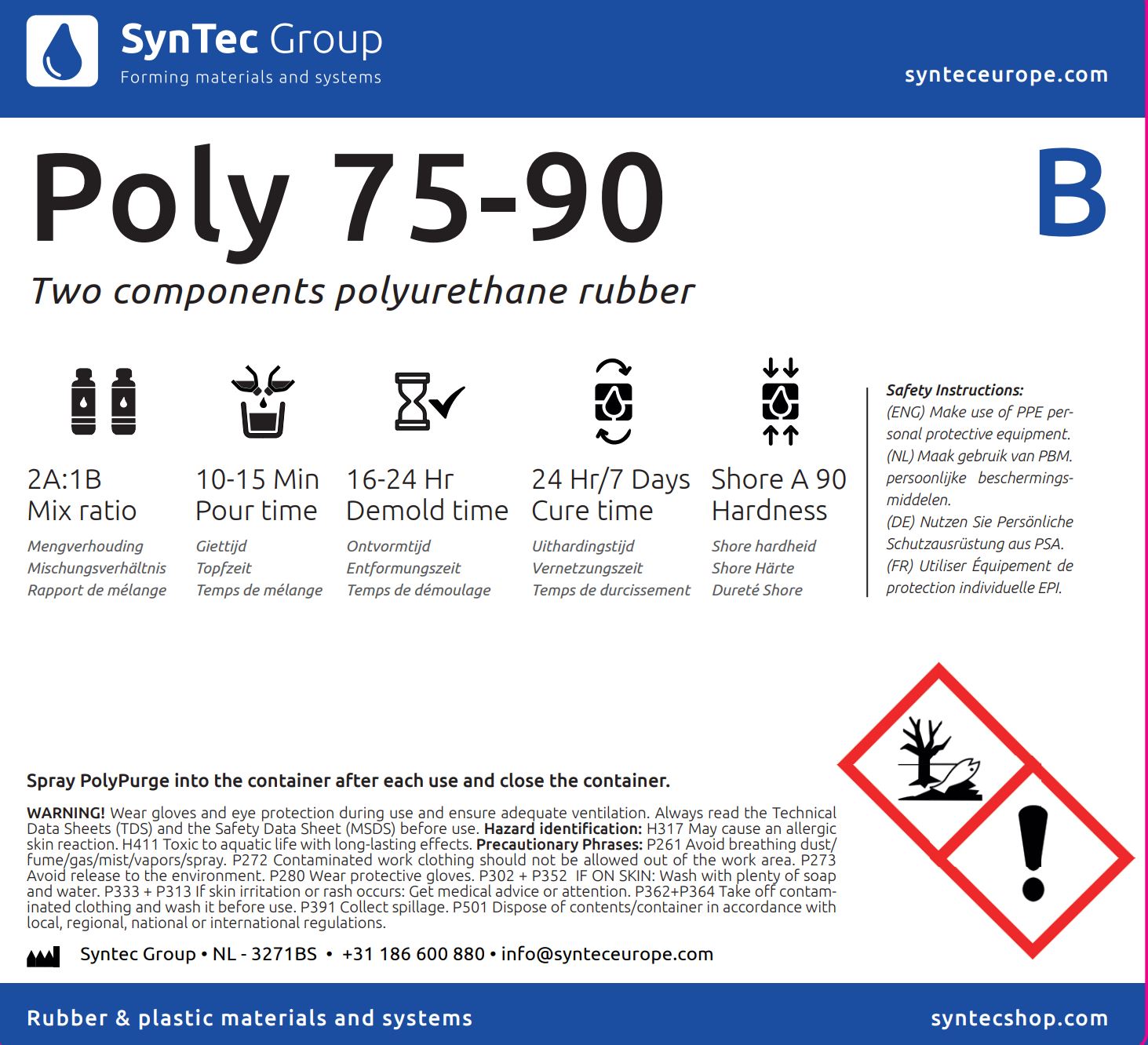
The Poly 75-90 liquid casting rubber is the hardest variant in Poly series polyurethae products. The Poly 75-90 has a Shore A 90 hardness. The two components RTV cast rubber has a mixing ratio of 2A:1B, a processing time of 10-15 minutes and a deforming time of 17 hours. The Poly 75-90 is also easy to thicken with a polyurethane thickener such as the CAB-O-SIL. The Poly 75-90 does have a high viscosity of 6.000 cP.
The Poly 75-90 is a hard rubber for making molds and between baffles for concrete, plaster or other heavy and large castings. Together with the Poly 75-75 and the Poly 75-80, the Poly 75-90 is also very suitable for hard rubber parts or applications. The Poly 75-90 adheres to many surfaces and surfaces. When no adhesion is required, the Pol-Ease 2300, Pol-Ease 2350 or release agent VL can be used.
Packaging: Set 612 kg, Set 3 kg, Set 15 kg, Set 54 kg, 612 kg
Hardness (Shore A): 90
Mix Ratio: 2A:1B
Working Time (min): 10-15
Total Cure (hr): 16 hr (demold) / 7 days (100%)
Viscosity (cP): 6.000
Color: White – Brown (creme – light brown)
Tear Strength (N/mm2): 64.44 kN/m (368 PLI)
Tensile Strength (N/mm2): 13.65 mPa (1.979 psi)
Type product: Polyurethane rubber
Release & Adhesion
Polyurethane casting rubber such as the poly 75-90 adheres when casting on many surfaces such as various types of metal, wood, polyurethane, plastics, epoxy materials, concrete, plaster and many more other surfaces. If release is required on these substrates, release agents such as our Pol-Ease 2300, Lossingsmiddel VL, Pol-Ease 2350 and Pol-Ease 2450 or the other release agents must be used. We always advise to first do a test with the adhesion, release or the suction effect of the rubber on the mold or application. With porous parts made of, for example, wood or plaster, the rubber can be sucked up. You can prevent this by first sealing it with, for example, a pore sealer. This is not a release agent, so if it still needs to be released or is poured with a material that will give you adhesion, use a release agent.
As standard, a polyurethane does bond and silicone does not bond to different materials. This adhesion or no adhesion is not for every material. If you want to generate extra adhesion for, for example, (mechanical) load, we always recommend optimizing this by using an ashesive primer for the different substrates. This gives a good bond for both materials. Before using this adhesive, the surface must be thoroughly cleaned and degreased. Blasting or roughening the surface promotes adhesion with or without a bonding primer.
Casting polyurethane on a material with which no adhesion is created therefore does not require a release agent. Most silicone casting rubbers such as our siliconen Eurosil, Platsil (addition silicone) and SG C-sil (condensation silicone) do not bond with the polyurethane materials. So no separate means is required here. However, it is possible that when you use molds intensively, the releasing effect can become less. Then use the release agent before you start pouring.
Always make a test case before you get started.


From: €46,50

PolyTek
Eurosil
SG C-Sil
Platsil
Poly 74-, Poly 75- and Poly 81-series
PT Flex
EasyFlo
Poly-Optic
Zhermack
Asiga
DETAX
MoonRay
Pro3dure
Pol-Ease
Formech
syntecshop.com
Laan van Londen 140
3317 DA Dordrecht
Netherlands

© 2022 – syntecshop.com
Privacy and cookies | Terms and Conditions
All prices on syntecshop.com are exclusive of VAT.